Rue Amelot, 11th Arroundissement, Paris
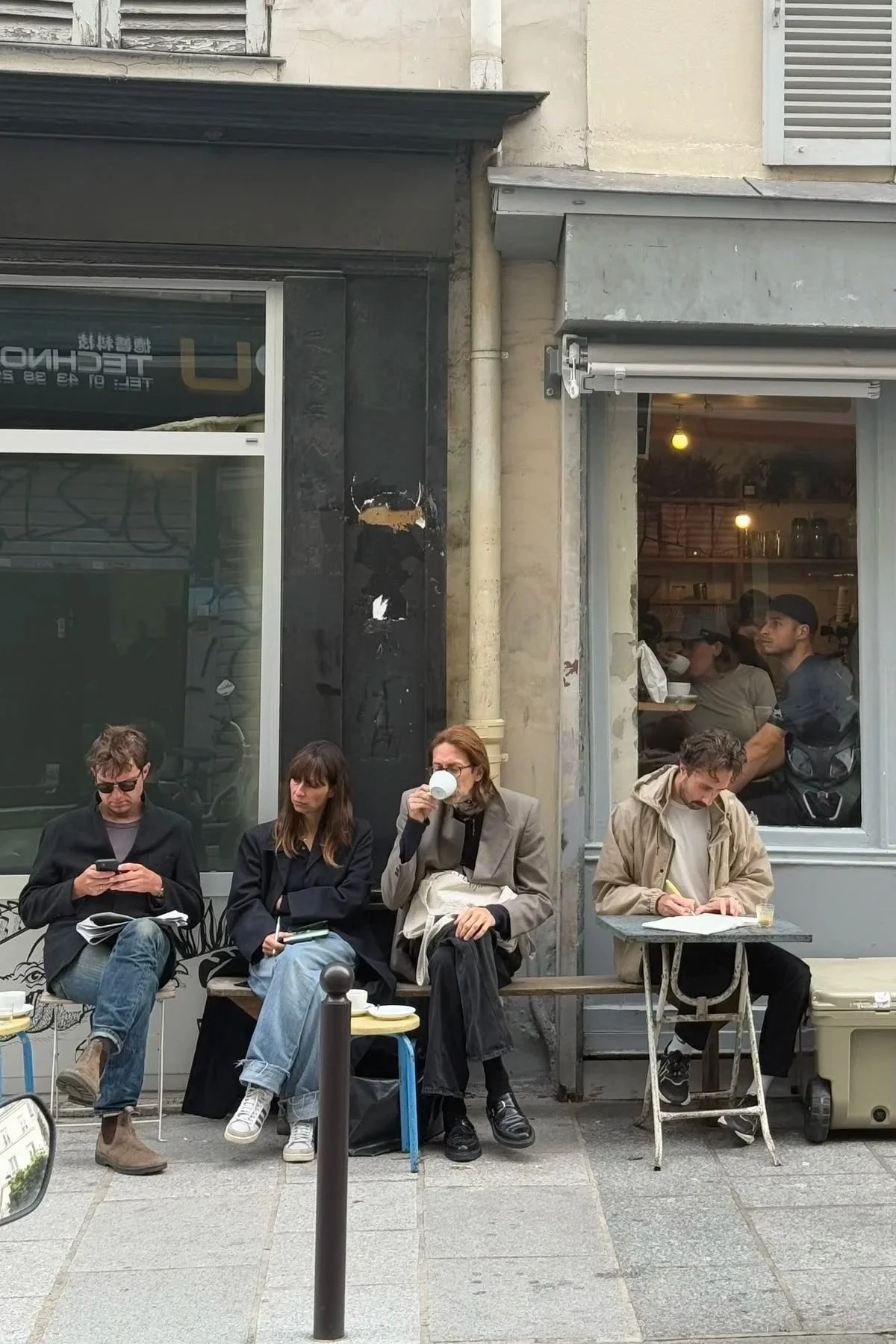
Dreamin’ Man Café, Paris
In September of last year, I flew to Malta then Naples then Crete and then Manchester. I took the train from Manchester to London and from London to Paris and from Paris to Cologne. I used to hate being constantly in transit. I’ve recently come to learn that the only reason I may have come to like it is because it gives me the impression of moving; of going somewhere when, in life, it doesn’t feel like I’m ever really going anywhere. I’m stagnant and afraid.
It’s early September. On the platform opposing mine is a girl with mottled honey- brown hair and sun-kissed skin. Her eyes glimmer but I can tell from the blue bags beneath them that she’s tired. I ask myself why this strange creature is staring at me and why I of all people on this platform should strike her as a worthy subject of study. That is until I realise, in my delirious, sleep-deprived state, that there isn’t a platform on the opposite side, it’s a mirrored wall serving me a reflection of myself. In the split seconds following my realisation, two thoughts cross my mind. The first is the vain and uplifting belief that I don’t look anywhere near as bad as I thought I would. The second is: what the hell is she still doing here? I know from experience now that the worst part about travelling and spending weeks if not months in transit is having to carry yourself with you. My first year travelling alone I was disappointed to come to the reality that I couldn’t leave myself at home— that wherever I went, there I was too. This burgeoning self-contempt, having been dormant for most of my life, buried under routine and obligation reared it’s ugly head when I first started solo-traveling.
Being alone in foreign cities, obscure towns, and remote Mediterranean villages made me aware of how little I enjoyed my own company. In her book, which deals with the nature of loneliness and urban estrangement, Olivia Laing observes that “loneliness is not lack of company, loneliness is lack of purpose.” Even in some of the most majestic landscapes, I was alone and not just alone but lonely. Faced with an abundance of nature and culture, I would try desperately to register some awe and wonder in myself— trying to appreciate my insignificance as a relief rather than a threat, but to little avail. Some of Caravaggio’s most celebrated art, the Acropolis, Monet’s Water Lillies— I could appreciate it all but it invoked a sense of despair in me. And perhaps it wasn’t only despair but envy. Any sense of urgency and inspiration had drained from my bones, leaving me inert and numb to art— the very substance of which I would never be able to emulate myself. This envy was stupid and unjustified but I felt it all the same. I felt the same way I felt after watching a truly great film: I never want to see it again, unless I can see it again for the first time.
I was expecting to be overwhelmed by what F. Scott Fitzgerald so eloquently expressed in the opening pages of the Great Gatsby as being the “inexhaustible variety of life.” Instead, I experienced an uneasy and at times disturbing sense of depersonalisation. I felt numb and estranged from the world— as though it were deliberately keeping me at a distance. For months there was a placidity in me that wasn’t easily perturbed. Alot of the time I was worried that I wasn’t worrying enough. One part of me felt I was wasting time and another insisted that even if I was wasting time, I shouldn’t worry about it. Wasted time isn’t unworthy of being spent. I was taking the scenic route and there was no need to feel guilty about that.
This feeling however— this numbness— made me feel I was at risk of wasting time. If I couldn’t appreciate my experiences in the moment, if my memory was being tainted by this unaccountable depersonalisation then what use were my travels to me in retrospect? I was so lucky and priveledged to have been travelling as much as I did so why couldn’t I just be happy? Such is the reality of travelling with someone you can’t escape from. And wherever I went, there she was, waiting for me.
Fortunately, when I got home to Germany, I adopted a rose-tinted view of my travels. With time, my loneliness struck me less and less as a matter of my own bad company and more like an issue rooted in my own deep reticence and yearning. Nonetheless, I distinctly remember the strange sensation of being on the sidelines of my own life— convincing myself it was okay because I wasn’t quite sure I wanted to enter the arena anyway. In Paris, Barcelona, Bordeaux, Athens, Valletta, Copenhagen, I would revolt only to succumb to the movements of my existential malaise. Roaming streets, feeling like an uninvited guest in my own body; a restless stranger in my own skin. I felt like the ballads I listened to. Aimless but visceral and brittle, on the verge of breaking. Sad cowboy songs. The likes of Mazzy Star, Jeff Buckley, Mac deMarco, and Lucio Battisti accompanying me on every flight, every ferry and train ride.
It was only years later, returning to Europe, that I could begin to stich myself back together, tracing the sutures of my fragmented self and mapping out a private geography of solitude to find where I’d lost my way— somewhere between Sydney and Cologne, though I suspect it may have started long before I began travelling. Buried within the morass of my loneliness, was purpose. It was my ambition; ambition without action that had grown, gone untouched and boiled over, curdling like bad milk into anxiety. It was the bitter diagnosis of my restlessness and the hidden cause of my chronic procrastination. The numbness I felt was nothing more than a survival instinct, an attempt at self-preservation. It was my body protecting me from what my mind perceived as my cowardice catching up with me. It was only last year, on a rainy September day in Paris, that I finally accepted this fact.
I frequent the same cafés whenever I’m in Paris. My favourite is a small, hidden cafe named after the Neil Young song “Dreamin’ Man”. Whenever I wedge myself into a corner of this cozy establishment I’m surrounded by artists. I eavesdrop on their conversations and am filled with the essence of Paris. Expats, Parisians, writers and musicians all communing under the same roof, engaged in conversations or private rituals of writing and reading. And for the first time in forever I’m struck with the inexhaustible variety of life. The streets of Paris, however piss-stained or pigeon-trafficked they may be, hold an inimitable grace. Under the cloudy September sky, I felt somehow accepted by the city of lights; accepted but not yet fully embraced.
Having made the pilgrimage to my favourite cafe and sheltering from the rain, I order an americano with cold milk and a slice of homemade walnut cake. I sit down and I’m transported to my past visits to the city.
Paris. A labyrinth of Lutetian limestone and heritage landmarks. The heavens break open every now and then. A grey summer’s day. The suspended mass of car exhaust fumes cook in the early September heat. The rain ceases momentarily for a brief intermission of blazing hot sun, revealing tourmaline puddles— a curious stench of sulphur and sweating asphalt. Miraculously securing a table, I begin writing. I’m distracted every now and then by passers-by, my murky coffee and brown crumbs of cake stuck under my fingernails. I write about beaches and bad posture. I write about hitting the ground and burning out. I write about delay and the inevitable doldrums of the day— whether or not to visit Le Marais. I write until the page is full and my hand has had enough. That’s when I see her. That same girl I saw at St Pancras Station before boarding the train. She looks at me with eyes of compassion and tender comprehension. I reciprocate her reception, asking for patience. Eventually the rain stops and the sun comes out again. I make my way to Le Marais. I adjust my posture. I’m okay.