The Liminality of Being: Mysticism, Thin places, and Thrownness.
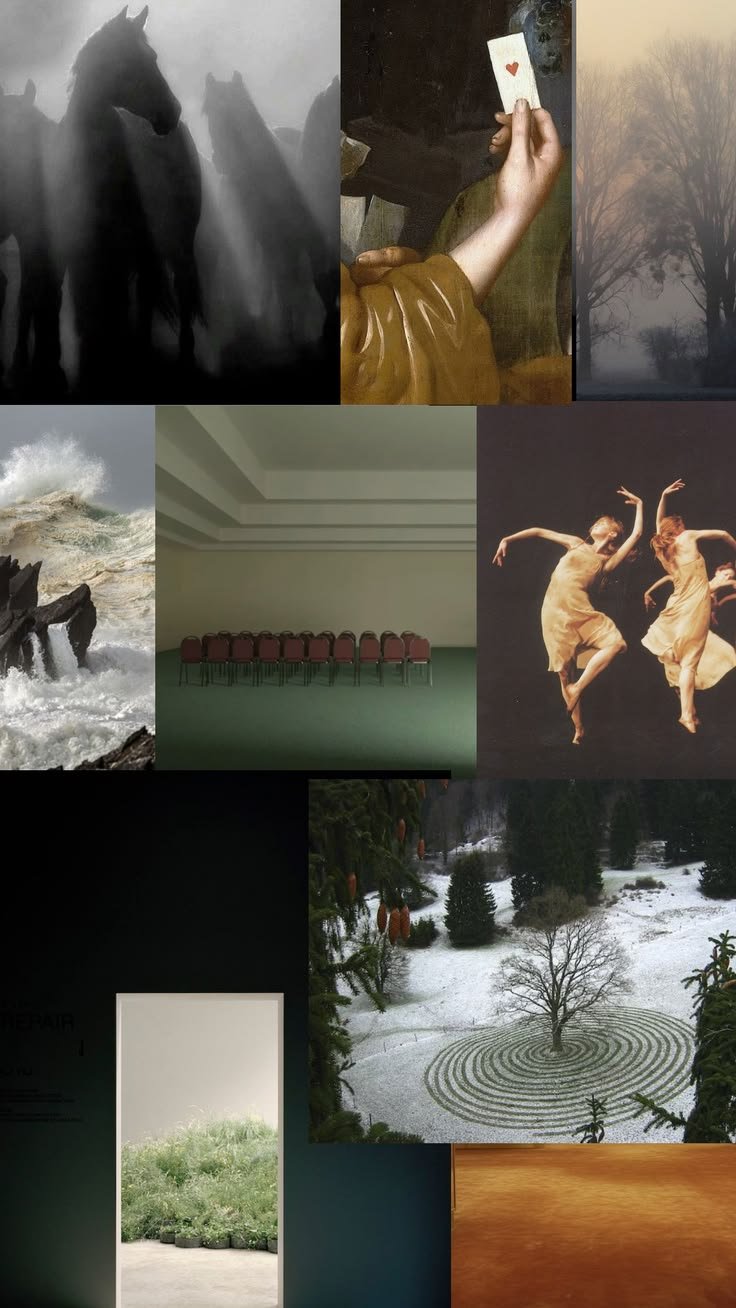
Have you ever found yourself in a moment so inexplicably sublime you want to live in it—put it in your pocket and take it home? Or perhaps it’s an eerie feeling of being on the periphery of something you can’t quite place. Liminality—that strange, inexplicable feeling of being lost yet not really wanting to be found either, is a strange sensation to put into expression. Sometimes invoked by nature or art of any form, liminality catches us in the crosshairs of our reality and a realm of phenomena beyond semantic explanation. While some may attribute this nebulous feeling to awe, others may identify it as an existential crisis. An ontological approach to liminality, however, can argue that this state is less a psychosis than it is an ascension of existential possibilities. In a liminal space, one is neither fully in one reality nor in another. Thus, the concept of liminality can be understood as a sensation of existing on a threshold. Aided by an eclectic soup of supplemented reading, the following essay will explore the concept of liminality through the lens of Mysticism, the Celtic idea of ‘thin places’ and the German philosopher Martin Heidegger’s theory of ‘thrownness’.
Origins
In its conceptual infancy, liminality was first articulated within the discipline of anthropology. The term was originally expressed by the French ethnographer and folklorist Arnold van Gennep. It was later expanded on by British cultural anthropologist Victor Turner. Anthropological studies observe that the concept of liminality first emerged within spiritual discourse. In particular, within the context of spiritual practice, anthropology views liminality as an ambiguous phase in rituals and rites of passage where social status is dissolved and new identity has yet to develop. Herein, the word “liminality” itself emanates from the Latin limen, meaning threshold.
Mysticism
In keeping with its spiritual origins, liminal spaces, in their arcane character are less radical when understood within a religious construct. In his 2024 book, ‘On Mysticism: The Experience of Ecstasy’, British philosopher Simon Critchley studies the role of mysticism and the experience of awe and exultation that can arise from it. Through the lens of Christian tradition, Critchley observes ecstasy as a sensation of “being outside oneself”. Despite not employing the concept of liminality himself, Critchley’s account of ecstasy aids an explication of liminality. By attending to the sublime ecstatic experience of mysticism, Critchley argues for the existence of a dimension that exceeds one’s subjective reality and yields complete freedom and openness. It’s precisely within this dimension that the ascension of one’s liminal sense can occur. This unique and allusive state of existential liberty and elation, however, isn’t restricted to religion alone. Historically, the spiritual reception of ecstasy, awe and liminality has been reduced to a purely theological understanding. The ecclesiastical apprehension of ecstasy is akin to miracles, divine apparitions, and the reverential fear of an omniscient God. However, in virtue of being a primarily spiritual rather than somatic revelation, the liminal state can just as well be aesthetic or romantic.
Celtic Thin Places
While Critchley’s take on mysticism offers a phenomenology of liminal ecstasy, the ancient celts provide a unique topography. The Celtic theory of thin places offers a spatial and temporal grammar for the ecstatic “outside of oneself” experience framed by Critchley. The ‘thin place’ embodies the liminality of one’s being and reveals an unintelligible aspect of the human experience. This is to say that thin places tap into a threshold state of consciousness ‘more real’ than our own reality. On this threshold, the porous nature between earth and the ethereal is unveiled. It’s a glitch in the matrix—a simultaneous feeling of being on the periphery of everything and nothing. However ridiculous it may sound, this experience is achieved without hallucinogens. The Celts believed that thin places can be reached in nature and time. Often bound by spatial and temporal boundaries, thin places amount to moments or sites belonging to the liminal in-between—twilight, midnight, shorelines, mountain summits.
Ancient mysticism holds pertinent value today. In pursuit of liminal ecstasy or not, mysticism can help alleviate our modern detachment style, even if just for a moment. What can today be diagnosed as a contemporary deficit of awe and wonder is also what Critchley otherwise terms an “abdication of ecstasy”. In this theory, Critchley recognises that mysticism isn’t amenable to how modern, secular culture functions. Seeking out thin places therefore holds the possibility of reconnecting us with our inherent but mostly unexplored liminality of being.
Heidegger and Thrownness
In his seminal work On Being and Time, the German philosopher Martin Heidegger describes human existence—Dasein (being-there)—as fundamentally shaped by Geworfenheit, or “thrownness.” Thrownness refers to the condition of finding oneself already in existence. The nature of our existence, according to Heidegger, is that we are thrown into the world as already being (dasein). Within a phenomenological framework, thrownness suggests that existence is spontaneous and largely passive, lacking any predetermined purpose or numinous structure of significance. As such, the concept of thrownness can evoke feelings of estrangement and exile. However, when reconciled with Heidegger’s ontological analysis of Dasein, thrownness transforms existential anxiety into a source for potential and possibility. Heidegger therefore advocates for a reorientation toward anxiety itself, framing it as a foundational mood necessary for Seinsverständnis—an understanding of Being.
The anxiety induced from recognising our thrown condition holds the power to momentarily place us outside ourselves. The sudden realisation that we exist beyond our situational awareness, routines, and quotidian obligations can feel jarring yet also liberating. After remaining dormant for much of daily life, the disruption can feel offensive and destabilising. To recognise that we exist only in relation to the world, rather than masters of it, can feel unsettling. In a sense, thrownness breaks the illusion of solipsism and exposes subjectivity as always already situated, affected and shared. Yet Heidegger encourages us to meet this disclosure with openness and optimism. For him, anxiety is inseparable from freedom. Because our anxiety is thrown, it is also open-ended. Where there is nothingness or indeterminacy, there is also the possibility of becoming. Our existence, by virtue of being thrown, is what we make of it.
Crucially, this anxious encounter with the strangeness of the world reveals a deeper sense of Unheimlichkeit, or “unhomeliness”—a feeling of not being at home in one’s own existence. Heidegger emphasises that this experience is revelatory precisely because the feeling of unhomeliness presupposes having felt at home in the first place. In this recognition, the significance of thrownness becomes clear and existential anxiety assumes an almost ecstatic quality. It is at this threshold that liminality emerges as a kind of salve for our temporal and environmental situatedness. Like thrownness, liminality evokes an uncanny mixture of awe and wonder at a world that we recognise as ours yet not of us, whose distance and mystery is also its beauty.
Liminal Places
So how does one reach a liminal state? Critchley and ancient mystics would argue it can not only be achieved through divine inspiration but in aesthetic experiences like music, poetry, and numerous other art forms. The Celts on the other hand would urge one to observe the seasonal change that occurs between October 31 and November 1. This period, known as Samhain marks the end of the harvest season and the beginning of winter. For Celts, Samhain sees ‘a thinning of the veil’ between the spiritual and earthly world; the seen and the unseen. Finally, Heideggar would argue that recognising our inherent thrownness launches us into a state of liminality wherein the disclosure of freedom situates us in a precisely liminal and finitely transcendent structure. This structure mediates between determination and possibility—the crosshairs of our conditioning and our constantly coming into being. Each of these unique schools of thought encourage a naïve immersion of the world; a world free of our hyper-rational, self-enclosed subjectivity. Mysticism, Celtic doctrine, and Heideggar all promote a suspension of familiar significances and ordinary securities in favour of being outside of ourselves for just a moment.
In our age of ecstatic abdication, within our contemporary lacuna of mystical culture, where experiences are commodified and consumed vicariously through screens, liminality cannot be put in your pocket and packaged for later use. The experience of liminality, when reached, holds an invisible power where beauty meets you and reflects its likeness onto you like a mirror. It makes us aware of our finite existence and the ability for ordinary instances to transcend the everyday. To anyone sensible of the sublime, liminality is a little less elusive. To the discerning soul, a liminal place can be an empty dimly-lit gym, a dilapidated petrol station along the highway — between where you were and where you want to go, it’s deserted islands and rural towns. Ascending to higher places on your commute to work, on the sticky dancefloor of a seedy club, on your suburban jog. Liminality is the inexplicable, ineffable, tenuous tie between always and never, somewhere and nowhere. It’s estrangement and yet it’s also freedom. It’s nothing and yet it’s everything.